Building collapses in the national capital have become increasingly common in recent years. An unspoken normalisation of unauthorised colonies has turned Delhi into a ticking time bomb—awaiting the perfect moment to implode.
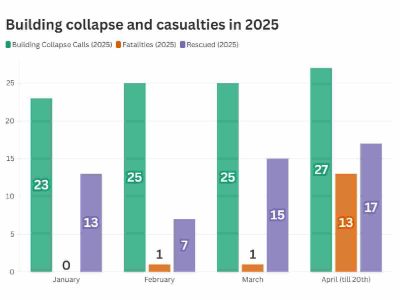
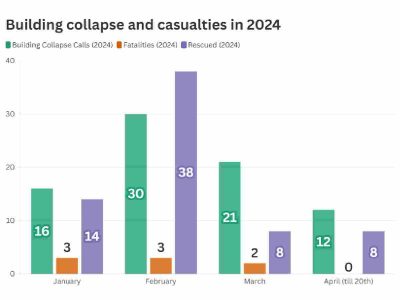
This year, the month of April has already seen a staggering increase in building collapse-related phone calls to the Delhi Fire Services (DFS). According to DFS data accessed exclusively by Patriot, there have been 27 such calls till April 20—up from 12 during the same period in 2024. This marks a 55.5% increase over the previous year.
This concerning trend is not limited to April. With the exception of February, every month this year has recorded more building collapse calls than in 2024. In January, February, and March 2025, there were 23, 25, and 25 calls respectively. In comparison, 2024 saw 16, 30, and 21 calls during the same months.
The human cost has also been greater this year. As of April 20, 15 people have died in such incidents, compared to eight deaths during the same period last year.
Further data reveals that this is part of a larger pattern. In the financial year 2022–2023, there were 349 reported collapses, resulting in 43 deaths and 315 injuries. In 2023–2024, the number of collapses rose to 371, though fatalities dropped to 23, with 171 injuries.
These figures reflect the growing climate of fear in the national capital, particularly among residents of unauthorised colonies—communities left to fend for themselves without meaningful support from municipal or state authorities.
The stepbrotherly treatment of Delhi’s unauthorised colonies
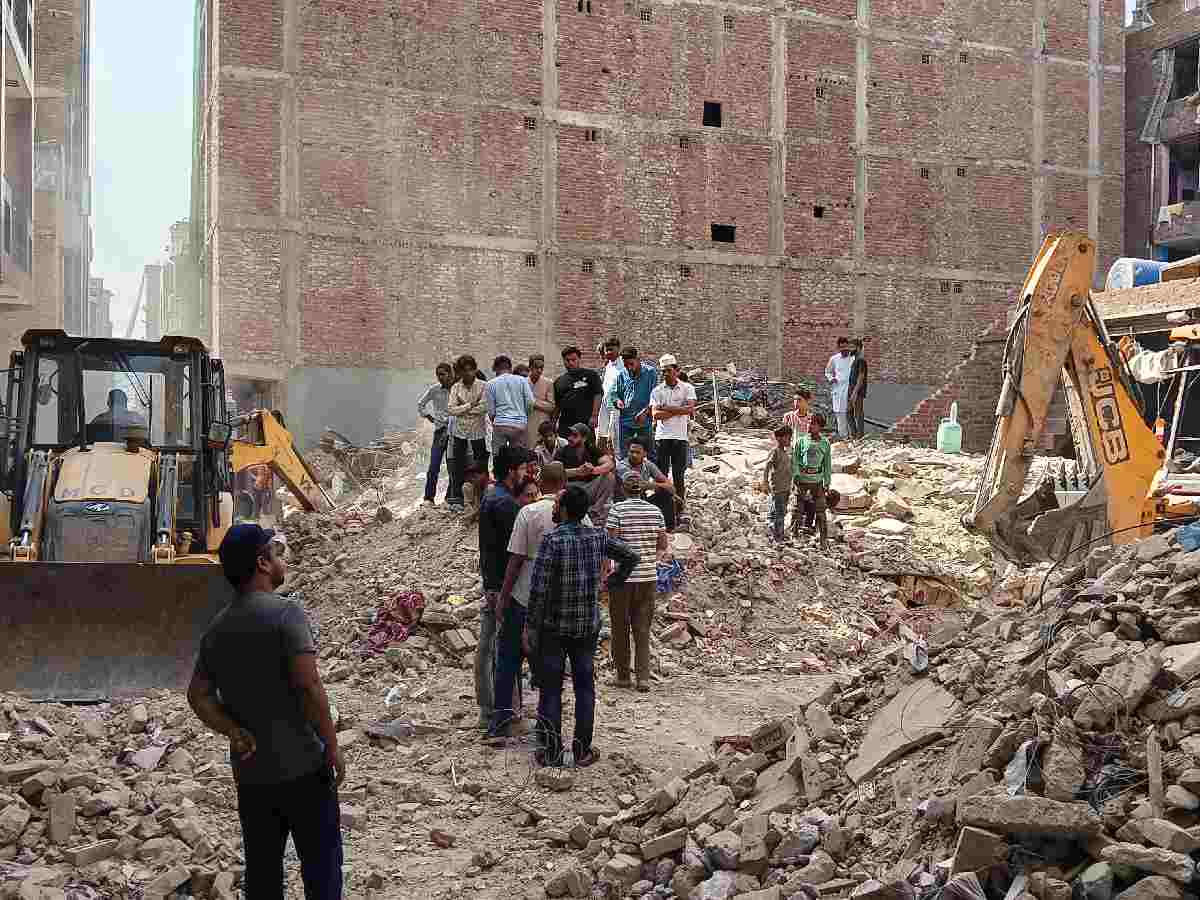
One of the worst recent collapses occurred in North East Delhi’s Mustafabad last week. A four-storey building—nearly two decades old—collapsed in a narrow alley, killing 11 of the 22 residents inside. The structure came down like a house of cards, offering no chance of escape.
Among the deceased were eight members of the same family, who had also lost a relative during the North East Delhi riots in 2020. Tehseen, the building’s owner and father of the riot victim, was among those who died.
The 11 deceased were identified as Tehseen, 60; Zeenat (Tehseen’s wife), 58; Nazeem (Tehseen’s son), 30; Anas (Nazeem’s son), 6; Shahina (Nazeem’s wife), 28; Afree (Nazeem’s daughter), 4; Afan (Nazeem’s son), 2; Chandni (Tehseen’s daughter-in-law), 23; and Ishaq (Tehseen’s relative), 75. The others were Danish, 23; Naved, 17; and Reshma, 38.
Also Read: Overcrowded and affected by substance abuse: Issues ailing Delhi’s juvenile care institutions
Only three members of Tehseen’s immediate family survived: his son Chand, 25, and grandchildren Shan, 4, and Sanya, 2.
Residents suspect that long-term seepage issues played a significant role in the collapse. Mohammed Gulfam, a 52-year-old resident of Dayalpur colony, said the area had never seen such an incident before. He pointed to the poor condition of sewer lines, citing excessive seepage as a likely cause. According to him, this moisture has weakened building foundations over time. He added that despite residents repeatedly facing problems such as damp walls, the government had done little to fix the underlying drainage issues.
The frustration was echoed by Tehseen’s brother, Mohammed Hajibullah, 62, who lives on Gully No. 2 in the same colony. Hosting the bereaved families in his home, Hajibullah said the locality had long suffered from clogged and overflowing sewers. He lamented that neither the local councillor nor the MLA had taken steps to resolve the problem. While he acknowledged that death is ultimately in the hands of God, he insisted that the collapse itself was man-made—a tragedy enabled by systemic neglect.
Seepage or illegal construction?
Preliminary investigations by the Delhi Police suggest that ongoing renovation work, particularly the demolition of a wall, may have triggered the collapse. The rescue operation has concluded, with no survivors found beneath the debris.
An FIR has been filed under sections 290 (negligent conduct regarding building repairs), 106 (causing death by negligence), 125 (act endangering life), 125A, and 3(5) (common intention) of the BNS against unidentified individuals. While the building’s owner died in the collapse, the Municipal Corporation of Delhi (MCD) has suspended five officials in connection with the case.
According to the FIR: “A wall between two shops on the ground floor was removed during renovation work… It has been established that the building owner demolished the wall between the shops, violating building regulations and committing a negligent act.”
The MCD echoed these findings, sealing 15 other vulnerable buildings in the area and announcing plans to demolish the structure adjacent to the collapsed one. However, a larger issue remains unresolved: the unchecked existence of unauthorised colonies.
“These incidents will keep happening due to the widespread presence of unauthorised colonies,” said an MCD official, requesting anonymity. “These follow none of the by-laws, and most officials fail to take cognisance.”
How unauthorised colonies persist despite crackdowns
According to the Delhi Development Authority, there are 1,731 unauthorised colonies in the capital, along with 69 so-called affluent unauthorised colonies in Delhi’s upscale neighbourhoods. Despite their different demographics, neither type follows civic norms or building regulations.
Architect Pradeep Sharma attributed the problem to both the age of these buildings and the use of inferior materials. He explained that structures in unauthorised colonies tend to deteriorate faster and have a shorter lifespan than those in planned areas. “Even a 20-year-old building can collapse,” he said, adding that subpar construction practices are widespread due to a lack of oversight.
Pushkar Pawar, a senior urban planner formerly with the MCD, concurred. He said building collapses are not normal occurrences but are often the result of widespread violations. “These structures breach multiple rules,” he noted. “They use poor-quality materials, ignore the required spacing between buildings, and exceed approved height limits.” He explained that builders often submit plans for three-storey houses and then construct five-storey structures, forgetting that the foundation is only designed to bear the load of three floors.
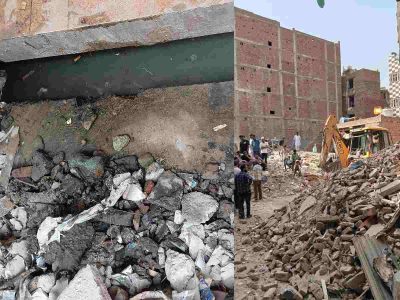
Firefighters involved in rescue operations shared similar concerns. One official said most collapses happen in unauthorised areas, where additional floors are added rapidly without assessing whether the land is even suitable for construction. Referring to the Burari incident in January, where five people died, the official noted that the land had been unfit for multi-storey development.
April dust storm triggered fresh collapses
On April 11, a dust storm struck the capital, causing multiple building collapses, two deaths, and three injuries.
In Chander Vihar, Madhu Vihar, a wall on the sixth floor of an under-construction building collapsed at 6:30 PM, killing 67-year-old Chander Pal and injuring Rajbir Meena, 38, a nursing officer. The injured were taken to Lal Bahadur Shastri Hospital, where Pal was declared dead.
At 6:51 PM in Karol Bagh’s Siddhipura, strong winds caused a newly constructed balcony on the third floor of a four-storey building to collapse, injuring a 13-year-old boy passing by. Police are pursuing legal action.
In another incident in Dwarka’s Kakrola, a building’s parapet fell, fatally injuring 10-year-old Avani, who was declared dead at Tarak Hospital. Her aunt, 31-year-old Savitri, was hospitalised at DDU Hospital.
By 10 PM, the Delhi Fire Services had responded to five building collapses and 18 fallen tree cases across the city.