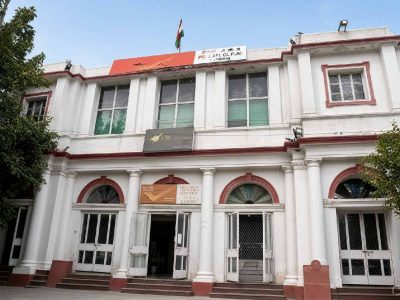
Noted businessman and Congress leader Lala Onkar Nath was among the first buyers of a car — a Fiat — in the capital. That was in the mid-1950s. Those were the days when very few people had cars in and around Sabzi Mandi, Kamla Nagar, Model Town, and Shakti Nagar. Lala Onkar Nath purchased his Fiat from Prem Nath Motors in Connaught Place. If you had seen the Prem Nath Motors showroom, you would have noticed a very small petrol pump outside it. It may have been set up along with Connaught Place in the 1930s, or perhaps slightly later.
In fact, the Connaught Place area has more than half a dozen petrol pumps — a sign that it attracted a significant number of cars, even when few locals could afford one. But that is history, as Delhi has come a long way since those days.
Cut to the present: Delhi has earned the tag of India’s vehicle capital. According to the Economic Survey of Delhi 2025–26, tabled in the Assembly recently, the city added more than 643,000 vehicles in a single year — the highest jump in nine years. The total motor vehicle population stood at 8.76 million (87.61 lakh) as of March 19, 2026, marking a 7.9% year-on-year growth — the strongest since 2015–16.
To understand today’s gridlocked metropolis, one must rewind to the colonial era, when motor vehicles were still a novelty for the elite. Until the 1940s, most residents relied on horse-drawn tongas, cycles, or the occasional tram. Yet the arrival of automobiles was already reshaping the city’s landscape.
Historical records from the era paint a clear picture. In 1918, Delhi had roughly 200 cars. By 1933, the number of cars and taxis on Delhi’s roads had crossed 2,000. These figures, drawn from traffic enforcement studies of the period, highlight how the automobile had begun its expansion even before Independence.
First petrol pump
Delhi’s first petrol infrastructure predated Connaught Place by a decade. The city’s oldest known petrol pump opened in 1923 near Novelty Cinema in Chandni Chowk, established through an arrangement with the Standard Oil Company (later Esso and now part of HPCL). Operated initially with hand pumps and metal drums, it served the small fleet of imported cars plying Old Delhi’s narrow lanes. Fuel cost about 10 paise per litre for petrol and 5 paise for diesel in those early days. By the time Connaught Place’s outer and inner circles were fully operational, petrol stations had come up to cater to the rising number of cars.
“These pumps were not mere conveniences; they symbolised the transition from bullock carts to internal combustion engines in a city still defined by its Mughal and British-era arteries,” says auto sector expert Vijendra Gupta, grandson of Lala Onkar Nath.
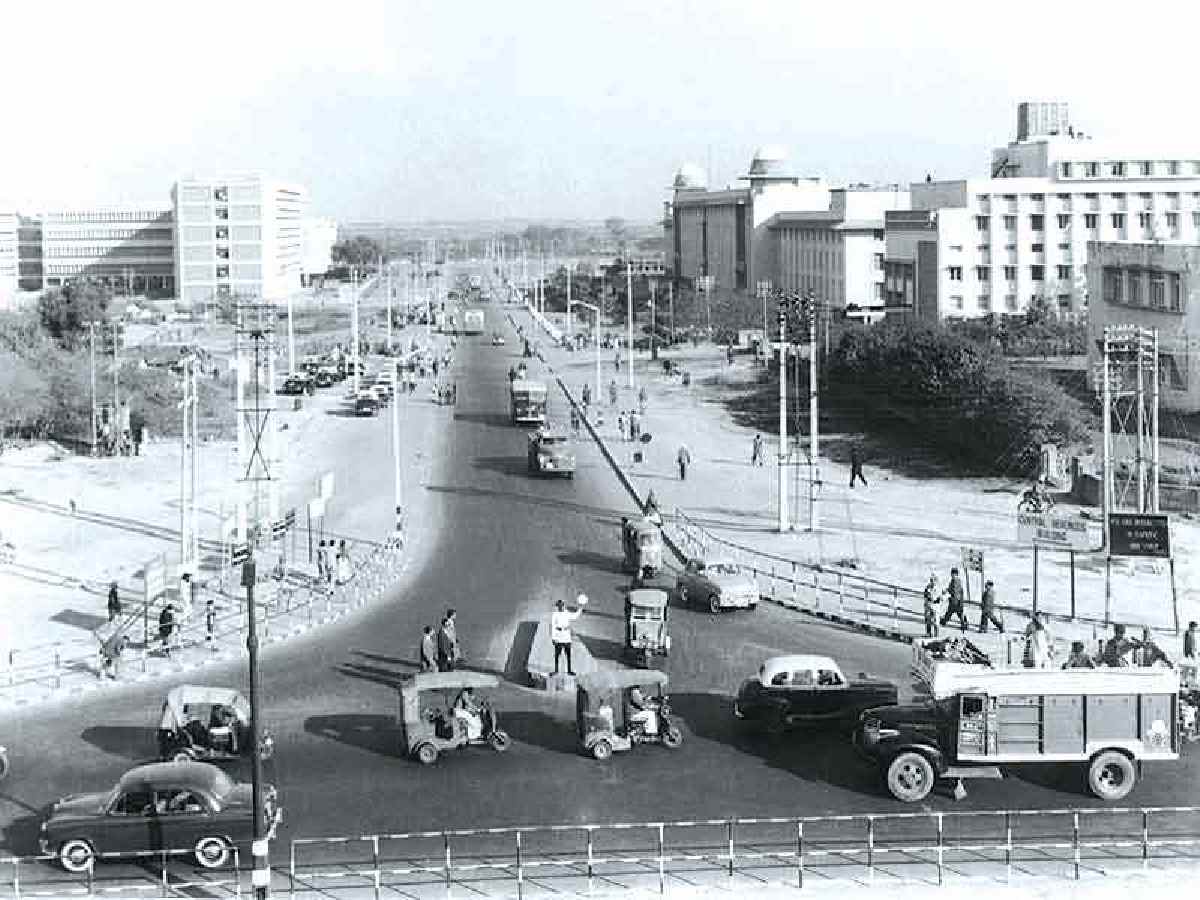
In the 1940s, before automated signals became widespread, policemen in crisp khaki uniforms stood in wooden boxes or on raised platforms, directing traffic with hand signals and whistles. “Till the late 1950s, the capital had only two dedicated DSPs for traffic operations. Of course, Delhi was a very small city. We did not have East Delhi except for Shahdara, Gandhi Nagar, Krishna Nagar, and the surrounding villages. There was no South Delhi except for villages, or perhaps Green Park,” said JS Joon, a former ACP of Delhi Police.
Solitary sentinel
Vintage photographs from 1940 show solitary officers managing traffic outside the newly built Parliament House or along Parliament Street. Exact numbers for dedicated traffic policemen remain sparse in public records, but the overall force’s modest size suggests traffic duties were handled by a limited number of officers citywide — managing a vehicle population that, while growing, was still far smaller than today’s.
“I believe that before the arrival of Ambassador and Fiat cars, even wealthy Delhiites could afford only Morris and Austin cars. They were British models. Only the very rich drove Rolls-Royce and similar luxury cars,” says Santokh Chawla, whose father, noted tent businessman Sardar Sewa Singh Namdhari, purchased a Morris for Rs 2,000 in 1968 from Kalsi Motors. That was likely the first privately owned car in East Delhi. Namdhari added another milestone when he purchased an imported Chevrolet in 1975 at an auction at the Oberoi Maidens. It is said that people in East Delhi visited Krishna Nagar just to see these cars.
Middle-class aspirations
The auto scene remained limited until the late 1960s, as few people in the capital could afford a car. By the 1970s and 1980s, two-wheelers proliferated as middle-class aspirations rose. Delhi’s registration system evolved, with prefixes like DL reflecting its status as the national capital.
“The real acceleration came after the 1991 economic liberalisation. Foreign investment, joint ventures, and relaxed import rules expanded the market with Maruti, Hyundai, and later global brands. Delhi’s roads became a reflection of India’s auto growth. Two-wheelers, cars, and commercial vehicles multiplied. Between 2001 and 2011 alone, major Indian cities saw vehicle populations surge, with Delhi leading,” says Mukesh Dayal Sharma, a former District Transport Officer in the Delhi government.
By the 2010s, the city grappled with smog, congestion, and measures such as the odd-even scheme. The 2020s have seen electric vehicles and metro expansion, yet the internal combustion engine’s dominance persists.
Also Read: From Karol Bagh to Tis Hazari, marking Good Friday
Today’s 8.76 million vehicles tell a story of aspiration and strain. The addition of 643,000 vehicles in a single year is equivalent to adding an entire mid-sized city’s fleet. Traffic police — now numbering in the thousands under a specialised Traffic Police wing within an 83,000-plus Delhi Police force — use cameras, apps, and AI, yet manual intervention at bottlenecks remains common. The contrast with the 1930s and 1940s is stark: from a handful of officers directing traffic to a digitised system that continues to face pressure.
Shift to liberalisation
Post-Independence policies shifted from control to liberalisation, unlocking growth but also contributing to pollution and congestion. Delhi’s status as a vehicle capital brings both opportunity and challenge: it supports economic activity, yet requires sustainable solutions — better public transport, stricter emission norms, and integrated urban planning.
As the city is set to reach 10 million vehicles in the near future, the lessons of its nearly century-long journey remain relevant. From a few hundred cars in 1918 to 8.76 million today, Delhi’s roads have witnessed significant change. The next phase will depend on how the city manages mobility and sustainability.