
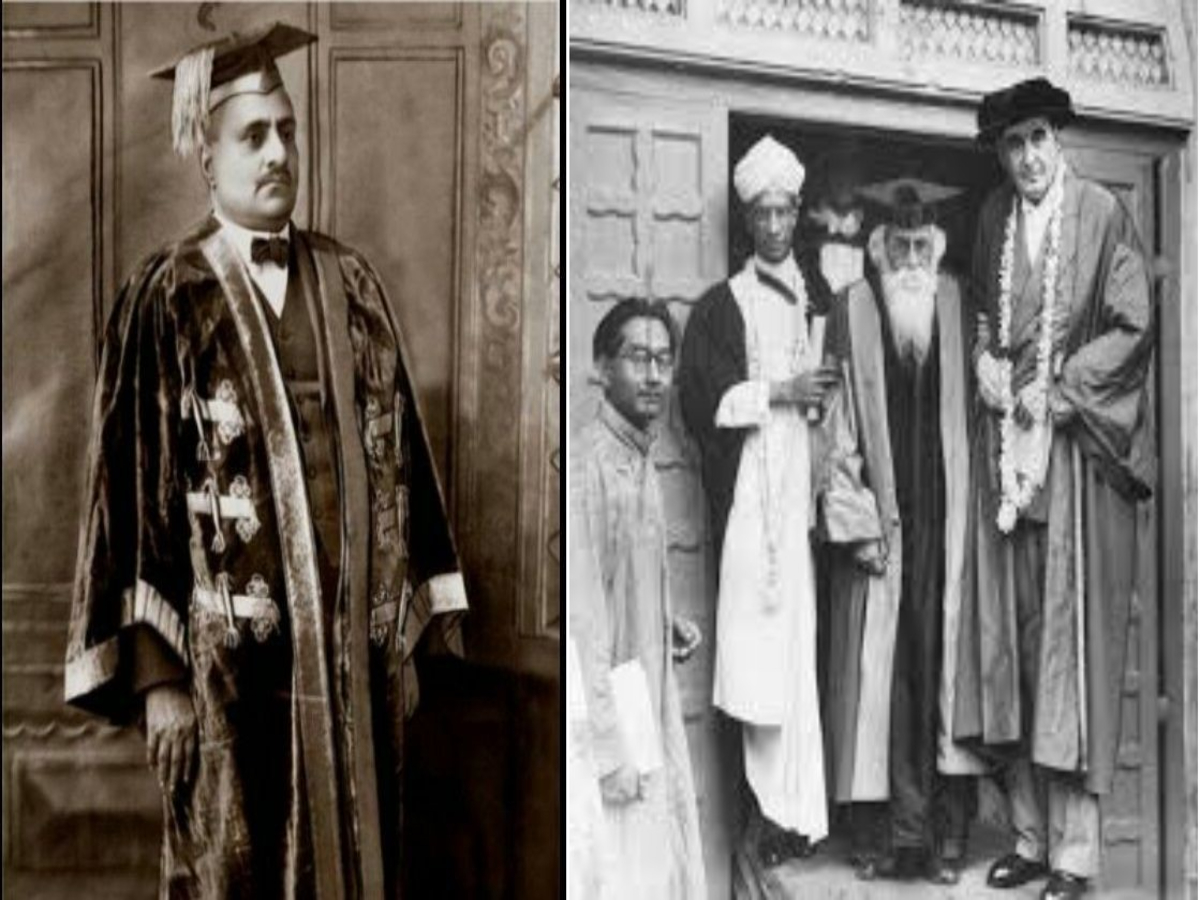
Whenever Delhi University appoints a new Vice-Chancellor or extends the tenure of an incumbent, two names often resurface in discussions about the institution’s history: Sir Maurice Gwyer and Hari Singh Gour. The two men led the university during its formative decades and helped shape its academic and institutional identity. Most recently, their names returned to the conversation after Vice-Chancellor Yogesh Singh received a five-year extension.
One of them, Sir Maurice Linford Gwyer, is remembered across the campus in more ways than one. Maurice Nagar and Gwyer Hall both bear his name, a reminder of the influence he had on Delhi University during his long tenure as Vice-Chancellor.
Building an institution
Sir Maurice Gwyer changed the course of DU. He served as Vice-Chancellor from 1938 to 1950, the tenure coinciding with a period of significant institutional growth. Born in London on April 25, 1878, he was a lawyer, judge and academic administrator. Before coming to DU, he had already made history by serving as the first Chief Justice of the Federal Court of India (the predecessor of today’s Supreme Court) from 1937 to 1943. He was also a key drafter of the Government of India Act of 1935. Educated at Oxford, he brought an Oxbridge spirit to Delhi.
When Gwyer took charge in 1938, DU was a small and struggling institution. He submitted a memorandum to the government in 1939. In it, he envisioned DU as a “field of ambition” and a “miniature Oxbridge.”
“He wanted it to be an all-India university that would bring together students from every part of the country, every class and every creed. The government supported him with grants. Under his leadership, the three-year BA and BSc Honours courses were introduced, postgraduate teaching expanded, laboratories were set up, and outstanding professors were recruited from across India. He improved salaries and built staff quarters. He invited figures such as EM Forster to lecture,” says Professor Raj Kumar Jain, who taught at DU for around 40 years.
In sum, he turned a modest university into a national centre of learning. Many still call him the “maker of the modern Delhi University.”
The heart of campus life
Named in Sir Maurice Gwyer’s honour in 1948, Gwyer Hall is DU’s oldest men’s hostel. It began as Law Hall in 1937–38 with just 26 residents, but funding constraints delayed its completion. After Independence, it was completed and renamed Gwyer Hall.
“Sir Maurice took a deep personal interest in its construction. He is said to have stood in the sun supervising the work so that students coming from outside Delhi could have a proper home. From the beginning, Gwyer Hall has mainly housed postgraduate and research students. Even today, it accommodates around 158 scholars,” says Prabhanshu Ojha, who lived here and heard stories about Sir Maurice from the old staff working in Gwyer Hall.
Former residents of Gwyer Hall retain a strong emotional connection with the hostel. The walls, the trees, the greenery and even the cats remain etched in their memories. Ojha, who now teaches at Hansraj College, says Gwyer Hall alumni invariably remember Sir Maurice and the hostel’s sweet samosas whenever they meet.
The sweet samosas, prepared for decades at the Gwyer Hall canteen by Pandit Jaikishan Pandey (fondly known as Panditji) and later his son, became well known across the campus. Filled with dry fruits and mawa, they attracted not only hostel residents but also students who later became prominent public figures, including Arun Jaitley, Ajay Maken, Vinod Dua and Rajat Sharma, besides many professors.
A lasting legacy
Gwyer Hall also shares an architectural legacy with several of Delhi’s landmark buildings. Its architect, Walter Sykes George, also designed St Stephen’s College, Miranda House, the Regal Cinema block in Connaught Place and Sujan Singh Park. Known for his use of exposed red brick without cement plaster, George gave these buildings a distinctive architectural character.
Sir Maurice also founded Miranda House in 1948 under his direct patronage. After Independence, both Miranda House and Hansraj College became part of DU. In 1952, Gwyer himself explained why he chose the name “Miranda.” He gave three reasons: first, Carmen Miranda was his favourite actress; second, his own daughter’s name was Edith Miranda Gwyer; and third, Miranda is the beautiful and curious character in Shakespeare’s play ‘The Tempest’. He wanted the young women of the college to be as free-spirited and full of wonder as Shakespeare’s Miranda.
Gwyer is also remembered for his love of cats. The hostel he built has always had many cats. Residents developed an attachment with them. Attempts to remove the cats never succeeded. Sir Maurice himself is said to have kept cats.
“The area once known as Rajpur Quarters was renamed Maurice Nagar in his honour when he resigned in 1950. The Executive Council of the university paid glowing tribute to him, saying that the university as it stood was entirely his creation,“ says Professor Riaz Umer, who taught Accountancy at DU.
Before Gwyer
If Sir Maurice Gwyer’s legacy remains visible across the campus, the contribution of Delhi University’s first Vice-Chancellor, Hari Singh Gour, is remembered far less prominently. Yet his role in laying the university’s foundations was equally significant.
Gour made significant contributions to law, education, politics, literature and social reform. He rose from humble beginnings to become a famous lawyer and jurist, a member of the Central Legislative Assembly (1920–1935), and a progressive voice for women’s rights, the abolition of untouchability, and civil marriage. In 1921, he introduced the first bill against untouchability. He supported women’s right to become lawyers and the Civil Marriage Bill of 1923. He was also connected with the Simon Commission committees and the Constituent Assembly.
When Delhi University was founded in 1922, Hari Singh Gour was appointed its first Vice-Chancellor. He served from 1922 to 1926. In those early years, he prepared courses, set up departments, and raised academic standards. He accepted the unpaid but honourable post. In 1925, he was knighted for his services to education. DU later gave him an honorary D Litt. Under his leadership, the university expanded. The Chancellor (the Viceroy) often praised him.
Yet, DU has no major statue, hall, library, or garden named after its first Vice-Chancellor, while Gwyer Hall and Maurice Nagar keep Sir Maurice’s memory alive every day, Gour’s foundational work seems less visibly remembered on the campus.
Read More: Why Delhi was a big draw for Martin Luther King and Mandela