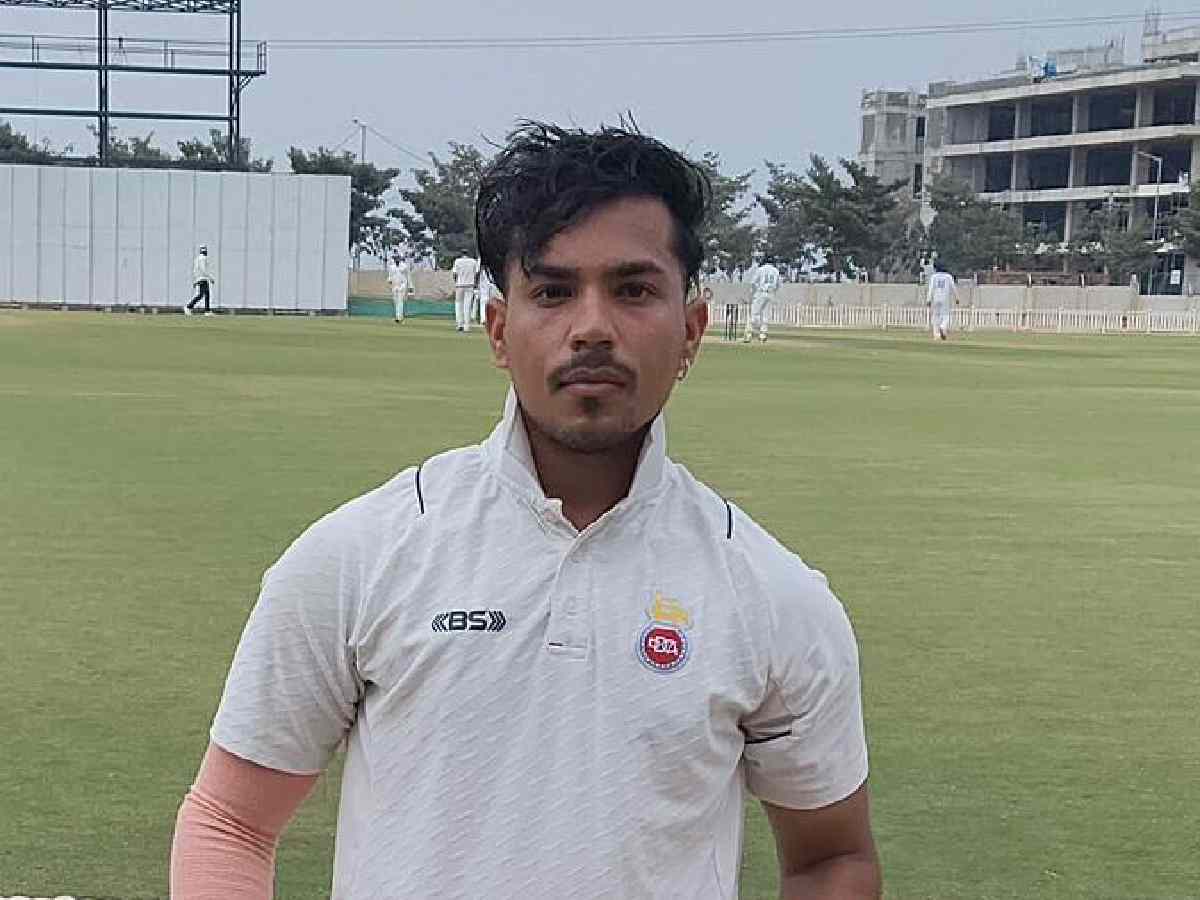
Ayush Doseja’s debut first-class season was unforgettable. The compact Delhi left-handed batsman hammered a brilliant double century on his Ranji Trophy debut against Hyderabad and ended the 2025-26 tournament with a colossal 949 runs, scored in just seven matches at an excellent average of 105.44, with four centuries. He ended up as the second-highest scorer, with Karnataka’s Smaran R pipping the prolific No. 5 batsman by a solitary run. Doseja’s 1150-gm willow produced a dream Ranji Trophy sequence: 209, Did Not Bat (DNB), 75, 64 not out, 17, DNB, 65, 62, 1, 64, 104 not out, 129, 0, and 159 not out.
Despite showing great form, Doseja was unfortunately not picked for any of the India A teams, the next step towards breaking into the Indian team. However, a few days ago, as a sort of consolation for him, the 23-year-old was selected in one of the four teams that will play an Emerging Players’ Tournament from July 6-24 in Bengaluru. These teams comprise the best performers of the 2025-26 Ranji Trophy.
Doseja also played in the 50-over Vijay Hazare Trophy and T20 Syed Mushtaq Ali Trophy last season, but the nimble-footed batsman didn’t get enough opportunities to showcase his repertoire of strokes.
Another positive was that Doseja’s excellent Ranji Trophy performance caught the eye of the Mumbai Indians, and its owner, Reliance, picked him for the T20 DY Patil Tournament in the off-season.
Excerpts from an exclusive interview:
How did you spend your summer after a fabulous Ranji Trophy showing?
After the domestic season, I came to know that I was in Mumbai Indians’ scheme of things. They called me for a short camp and picked me up in the Reliance team that played in the DY Patil Memorial Tournament in Mumbai. Then, I attended a 28-day camp at the BCCI’s Centre of Excellence, Bengaluru, for under-25 players who had performed well in the 2025-26 Ranji Trophy. The coaches included Wasim Jaffer, Vinay Kumar, Hrishikesh Kanitkar, Vineet Indulkar, and VRV Singh, and I benefited from the drills and match simulation, etc. that we underwent there. After that camp, I had a personalised short stint with Wasim Jaffer sir in Mumbai. He advised some technical adjustments in my batting. I also played in the 50-over Uttarakhand Gold Cup in Dehradun, where I captained a DDCA team, mostly comprising under-23 players. I performed well in the three matches that we played, scoring 73 against CAG, 138 against Uttarakhand, and 97 against Orissa, a match in which we successfully chased 309. In Delhi, I played in the Goswami Ganesh Dutt Tournament and scored a 40-ball century in a match. I played one more tournament in Kolkata, representing the Airports Authority of India, with which I am on stipend. Besides, I worked on my practice and training at private sessions.
On what aspects of your game did you work in particular?
I worked on power hitting for white-ball cricket. I feel that I have improved my game in the T20 and one-day formats in the last two years. I practiced clean hitting, playing the ball on its merit, and not just wayward hitting. And for red-ball practice, I created challenges for myself by starting practice at around 8 am when the pitch had moisture and seam movement was more pronounced. The idea behind early morning sessions was to prepare to play fast bowlers because in the Ranji Trophy, out of 90 overs in a day, around 65-70 overs are bowled by fast bowlers.
Did you work on your off-spin, too?
I didn’t work much on spin, as I was working more on my batting, training, and fielding. But, if required, I can bowl four overs in T20s, 10 in one-dayers, and even in multi-day matches. That much I have worked on my off-spin.
You were pipped to the second spot in the Ranji Trophy top scorers’ list by a solitary run. Was it heartbreaking for you?
To be honest, I wasn’t too disappointed. But my family members were very disappointed, and they felt that I missed out on a top BCCI award for the top scorer in the Ranji Trophy. Scoring 949 runs itself was a big thing for me, and I was the top scorer until the end of the league phase of the tournament. But Delhi was ousted before the quarterfinals, so it was not in my hand [to play more matches]. Had Delhi qualified for the quarters, and had I got one more innings, I feel I’d have scored more. Overall, I am very satisfied with the way my debut first-class season went. But I want to forget that season quickly because I want to perform better in the upcoming season.
In Vijay Hazare Trophy, you played only two matches.
I didn’t play the first two matches as Virat Kohli played in those. After he left, I played two games. In the second game, against Orissa, I had a Grade II hamstring tear while taking a run and was run out. I returned to Delhi from Bengaluru and recovered well for phase two of the Ranji Trophy. On my return, I scored centuries in both innings against Chhattisgarh.
You also had a very good DPL-2 season, scoring 300 runs in 11 matches at a brilliant strike rate of 136.98, and your team, West Delhi Lions, emerged as champions. How do you switch between white-ball and red-ball cricket?
It is not easy. You have to train yourself mentally. Throughout the entire season, you have to practice mixing the white and red balls, so that you don’t end up prioritising just one particular format. And I want to play all three formats at the highest level. So, I devote equal attention to both the red and white balls in practice. Switching between the two balls is a challenge, but I enjoy it.
Do you use bats of different weights in different formats?
I use lightweight bats in all formats. I use bats weighing between 1150 gm and 1170 gm, though there is not much difference between the two. Basically, it is all about balance.
Which bat did you use mostly while scoring those 949 runs in the Ranji Trophy?
I used the 1150 gm bat as it is lightweight. Basically, when the bat is light and has a good balance, you can control your shots and leave the ball easily. With a heavier bat, at times it is a bit challenging to play shots and leave the ball.
Despite doing so well in the 2025 DPL, you were not picked up in the IPL auction last December. How did you take it?
I was a bit disappointed. But I realised that I would have to perform better in the DPL and carve a permanent place in Delhi’s T20 team for the Syed Mushtaq Ali Trophy (a precursor to the IPL auction). Last season, I played just one match, that too after Delhi had crashed out of the tournament. I am confident that if I make a permanent place in the Delhi T20 setup and if I get to bat at my position – No. 3 – I would soon get into the IPL.
Since you scored heavily in first-class cricket last season, are you looking to get picked in the North Zone team for the Duleep Trophy starting on August 23?
Yes, I am preparing towards that end, and I am quite positive that I would get an opportunity and would also do well in the Duleep Trophy. That’s why I have doubled my practice, as I know all eyes are on me, and bowlers would make plans to get me out quickly. Therefore, I would have to be prepared for that. There would be no let-up in my hard work and following the processes. It is now the time to deliver, as the preparation phase is almost over.
And what is happening on your academic front?
The last of the four semesters of my MBA is left to clear. My online exams are scheduled for November. I am doing it at Subharti University, Meerut. I did my Bachelor of Commerce from Swami Shraddhanand College, Delhi. I am pretty good at studies: I got 89% in class Xth, 91 percent in XIIth, and A division (75 per cent) in the BCom programme.