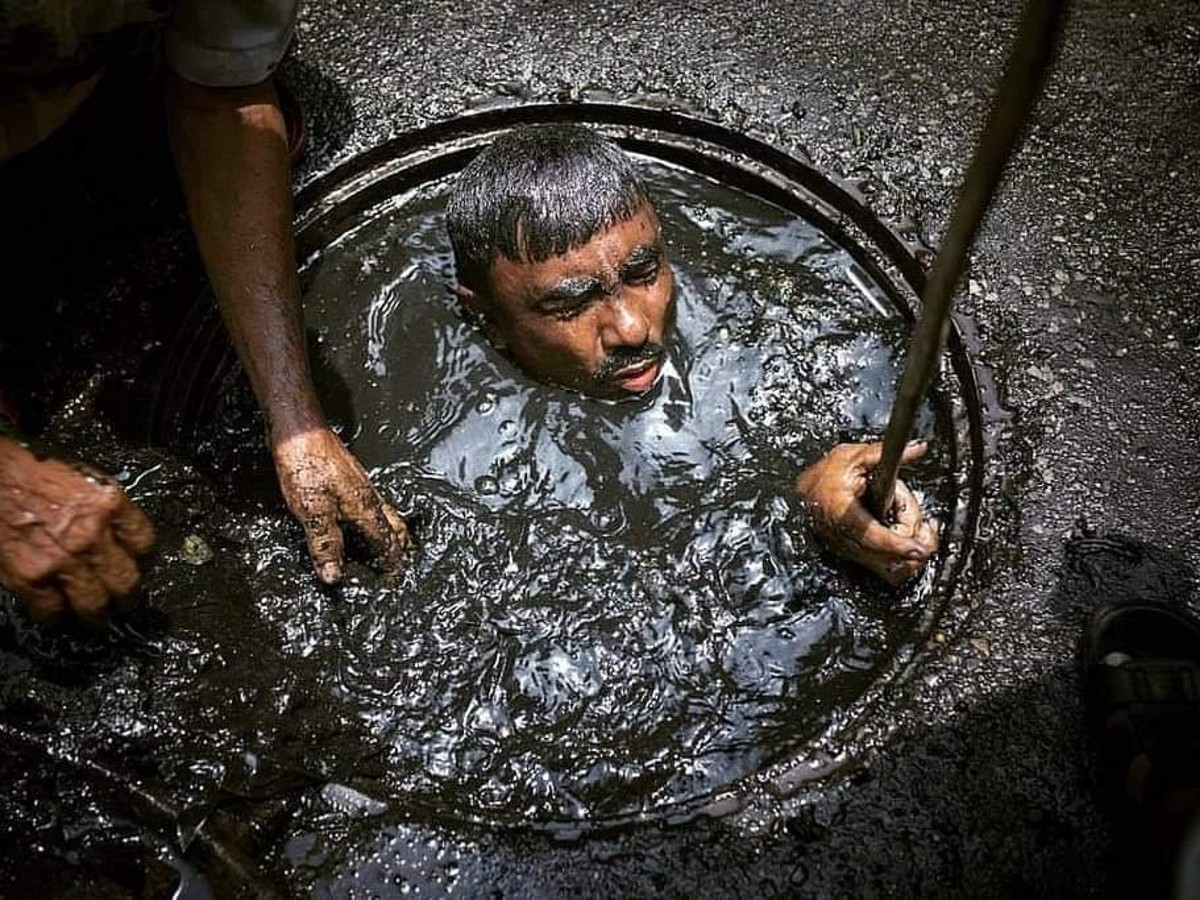
Seated inside his ramshackle abode, Jony has prepared himself for another bout of being at the Delhi Jal Board’s (DJB) mercy to secure his employment. Despite working for the water supply board for the past decade, he has never heard a single word regarding regularisation. Yet, he continues to dip into sewage drains to keep the supply clean, just to ensure food on the table.
The process is damaging his body, and he is aware of it. He is on the cusp of losing most of his sense of smell. However, if he refuses to work, someone else will go in his place. Thus, his decision to work becomes the difference between having enough money to survive the week or not.
“I could be doing manual labour at factories near Ghazipur, but that requires longer work hours and also yields much lesser money,” he said.
Armed with nothing but basic cleaning instruments, he works without safeguards. Protective gear mandated by the Delhi Government itself remains largely absent.
Safety schemes on paper
In May 2025, under the ‘NAMASTE’ (National Action for Mechanised Sanitation Ecosystem) scheme, it was mandated that 42 safety equipment items be used by manual scavengers. Under the scheme, 4,000 manual scavengers in Delhi were to be provided with Personal Protective Equipment (PPE) kits. These kits include gas masks, Wellington boots, and helmets to improve safety and social security for those cleaning sewers and septic tanks.
Delhi’s Social Welfare Minister Ravinder Indraj Singh also directed officials to enrol these workers in the Ayushman Bharat health insurance scheme and to expedite training and rehabilitation efforts. Furthermore, district magistrates were instructed to resolve outstanding compensation cases for sanitation-related fatalities in a time-bound manner to ensure workers are protected before the rains begin.
However, these measures remain unfulfilled, even among manual scavengers listed and empanelled with the government.
According to data available on the NAMASTE dashboard, 3,649 sewer and septic tank sanitation workers (SSWs) had been recognised till February 17, 2026, with 3,628 receiving PPE kits. Delhi also has 11 Emergency Response Sanitation Units (ERSUs).
An ERSU is a specialised unit established by urban local bodies to manage sewer and septic tank maintenance, focusing on eliminating hazardous manual cleaning. These units provide trained and equipped staff—often referred to as “sewer commandos”—along with mechanised tools to prevent worker deaths, operating under strict safety protocols.
While these initiatives mark a step in the right direction, significant concerns remain, especially since much of the work on drains and water supply is undertaken through the DJB.
Contract system and ground realities
The DJB empanels contractors who, in turn, employ workers like Jony to minimise costs.
“The periods right before and after the rains are the best for business. They come to me to get me to work. Moreover, since it means that a lot of dry drains also get clogged up with rain and wastewater,” Jony said.
Following the monsoon last year, the department deployed 32 ‘super-sucker’ machines and divided approximately 110 km of sewer lines into nearly 30 work packages. Each package covered a stretch of three to five kilometres. Contractors were appointed for each section, and the machinery has been operational for several months as part of a systematic cleaning programme.
The current desilting exercise has revealed extensive dumping of waste inside sewer lines, including construction debris, plastic waste, silt, and even cow dung, all of which have slowed the pace of work.
In several locations, the Delhi Jal Board also discovered temporary block walls inside pipelines. These had been erected during previous cleaning operations more than a decade ago to divert sewage flow but were never removed.
During desilting operations, sewage flow must be temporarily blocked and diverted using pumping systems to nearby drains or alternative sewer lines.
Workers allege systemic neglect
Azad Mehra, a field assistant with the DJB and a union leader of the Centre of Trade Unions (CITU), said, “They haven’t hired permanent sanitation workers in over two decades. Everything goes through these private agencies.”
He added that the reliance on contractors allows the department to avoid accountability. According to him, mechanised cleaning “only sounds good on paper,” as the drains are too deep for suction machines, making manual cleaning “technically necessary.”
“If they have to actually ensure that it remains clean and it works through machines then they will have to develop the entire city’s sewage system anew. That is technically impossible,” he said.
Mehra further alleged that the lack of regularisation helps authorities avoid paying minimum wages. “If they regularise [workers], then they will have to pay them the labour code ordained minimum wage… so this helps them save money,” he said.
Deaths and compensation gaps
Since 2017, Delhi has figured among the worst-performing regions in terms of deaths caused by manual scavenging, with 62 deaths. It trails behind Uttar Pradesh, Maharashtra, Tamil Nadu, Haryana, and Gujarat, and is the only Union Territory to feature high on the list.
In a Lok Sabha reply, it was revealed that out of 622 deaths reported across 21 states and Union Territories, 539 families received full compensation, while 25 received partial payments and 52 received nothing. Additionally, six cases were officially closed.
The discrepancy between fatalities and compensation was most pronounced in Uttar Pradesh, where 13 out of 86 families received no financial aid and two received only partial payments.
In Delhi, nine out of 62 affected families received nothing. Similarly, in Gujarat, two families remain uncompensated and one case has been closed, while in Maharashtra, nine families received no payment.
The national capital also records the highest number of complaints registered with the National Commission for Safai Karamcharis (NCSK), with 140 complaints. Uttar Pradesh follows with 130, while Maharashtra has 95.
Earlier in January last year, the Supreme Court passed an order banning manual scavenging in six metropolitan cities, criticising the Union Government over ambiguity in its eradication efforts.