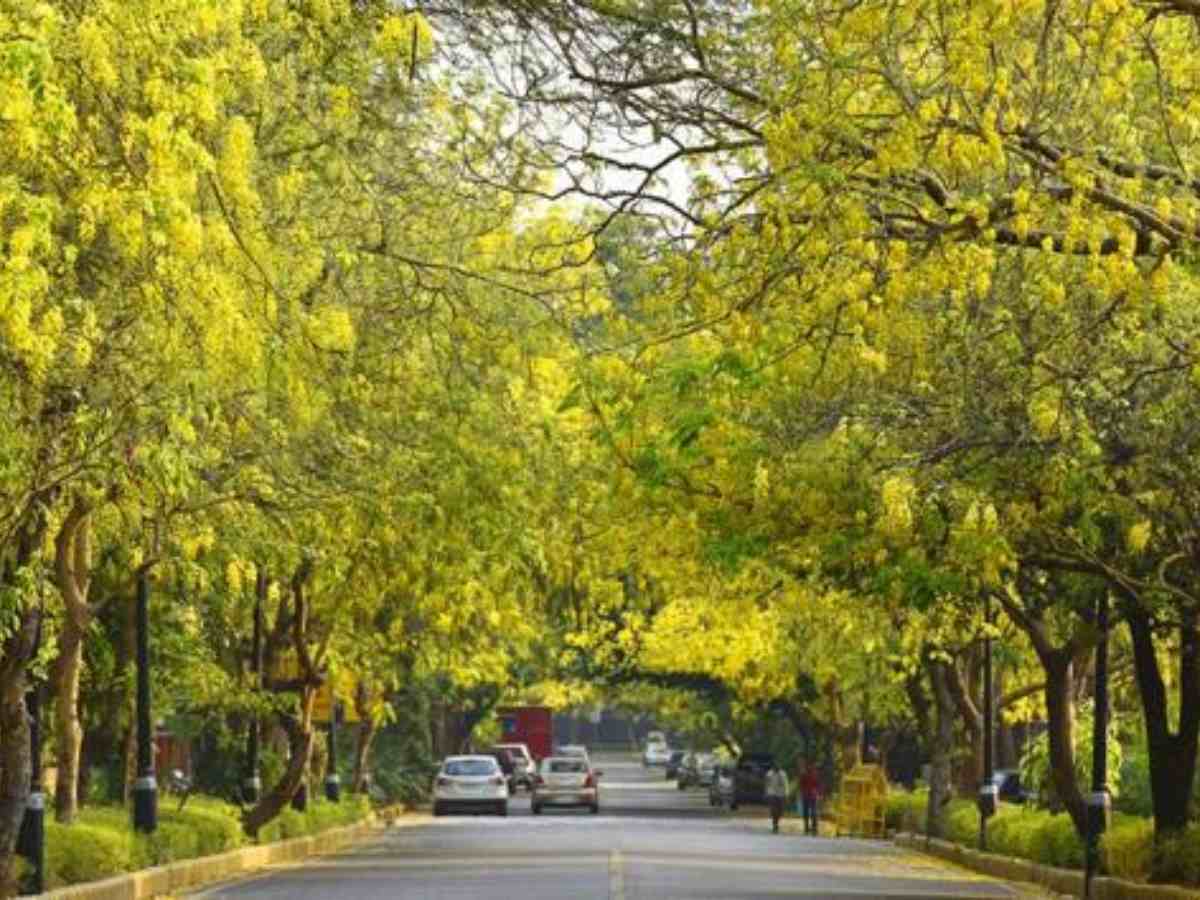
From Chandragupta Maurya Marg, move towards Amrita Shergill Marg. Here too, the amaltas trees shine like a shower of gold. You can also find them on Akbar Road, in Lodhi Garden, Pushp Vihar in south Delhi, and on Bungalow Road, Shanti Path, and the Jawaharlal Nehru University campus in north Delhi. In many parts of the city, these trees line long stretches of road, turning dull summer avenues into glowing golden tunnels.
A new arrival
Amaltas does not have a very old connection with Delhi. The New Delhi Municipal Council (NDMC) planted these trees for the first time in 1984 along roads such as Chandragupta Maurya Marg, Manas Marg, and Amrita Shergill Marg.
Babu Khan, who played a key role in the plantation of amaltas while working for the NDMC, said, “One special thing about amaltas is that it needs very little water. It can grow and bloom even with minimal care. This makes it perfect for Delhi’s dry weather.”
Amaltas trees are at their best from April to June. Their bright yellow flowers and long black pods easily catch the eye. The golden glow of these flowers is striking. Many people say that seeing these trees in full bloom feels like a moment of comfort in the middle of the harsh summer.
During British rule, planners mostly planted imli, peepal, and jamun trees in New Delhi. Anjan trees can still be seen on Pandara Road and near the parking area of the India International Centre. The anjan tree has drooping branches and small leaves with tiny flowers that often escape notice. Mahua trees can also be found on Rajesh Pilot Road. After Independence, newer varieties of trees were introduced into the capital’s landscape, and amaltas was among them.
Why Delhi loves amaltas
When temperatures cross 40 degrees Celsius, the appeal of amaltas becomes especially visible. The hotter it gets, the brighter the flowers seem to shine. It almost feels as though the trees are saying, “Your job is to give heat, and our job is to give comfort.”
On Bungalow Road in north Delhi, fallen yellow flowers carpet the road in the morning. Their sweet fragrance adds to the charm. In Ayurveda, amaltas — known as Aragvadha, or “disease killer” — is valued for its medicinal properties. Its fruit pulp is considered a gentle laxative, while different parts of the tree are traditionally used for skin ailments and digestive problems.
In a city often overwhelmed by heat and concrete, the amaltas offers a glowing reminder of nature’s resilience and generosity.
Amaltas blooms brightly for nearly three to three-and-a-half months during summer. After that, the tree appears comparatively subdued. But during May and June, it almost feels as though spring has briefly returned. The trees also support urban biodiversity. Bees, butterflies, and birds are frequently drawn to the flowers.
Hardy survivor
Amaltas trees grow quite tall. Babu Khan said they are ideally suited to Delhi’s dry climate. After planting, they require watering only every third or fourth day. Once established, they grow with little assistance. Scientifically known as Cassia fistula, amaltas is native to the Indian subcontinent and well-adapted to local weather conditions.
Prem Bhutani, an elderly resident of Delhi, recalled, “When we were growing up in the 1960s and 1970s, amaltas was not common in the Capital. But now, every summer, Delhi transforms into a golden dream when these trees burst into bloom. These graceful trees line the city’s avenues, parks, and ridges. Surely, the amaltas is one of Delhi’s most beloved seasonal spectacles.”
Radhye, a gardener working with the DDA, said, “These medium-sized trees thrive in the Capital’s hot, dry climate. Their vivid blooms contrast beautifully against the dusty summer skies and the deep green of neem and peepal trees. In places like Lodhi Garden, Nehru Park, and along Ring Road, you can see them in abundance.”
Amaltas is not just beautiful. It is hardy, requires little water, and brings colour to Delhi’s harsh summer streets. The next time the heat feels overwhelming, stand beneath an amaltas tree. Its golden flowers may briefly make the city feel lighter and more alive.