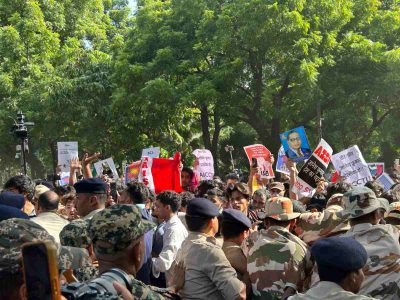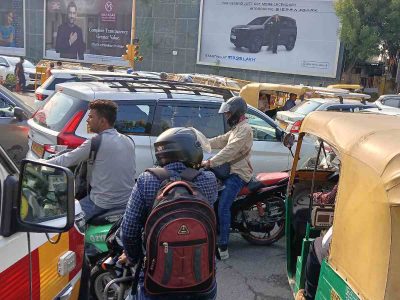
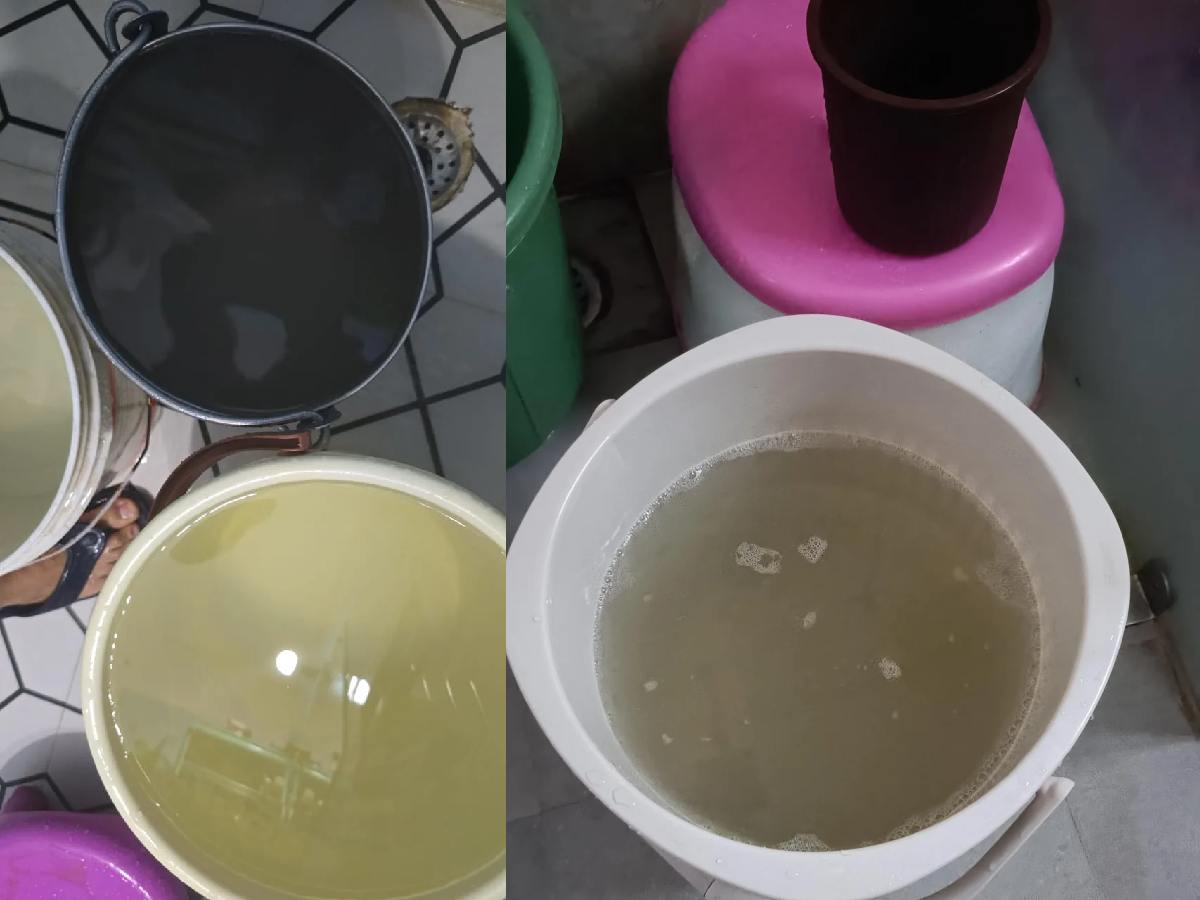
Just as the monsoon tends to bring with it floods and waterlogging in the Capital (picture the bus stuck under the Minto underpass), summers tend to be associated with record-breaking temperatures, water scarcity, and the supply of poor and, in some cases, hazardous quality water (picture residents posing with bottles of brackish water).
However, according to media reports, the issue of poor-quality supply this year is more widespread and is being reported from East, West and South Delhi neighbourhoods. As per daily updates received by the Delhi Jal Board (DJB), Ashok Vihar, Nasirpur, Mahavir Enclave, Ghazipur Village, Paschim Vihar, Kakrola, and Santosh Park are some of the most affected localities.
Testimonies of residents from these localities point to a deeper crisis.
In Ghazipur, Delhi’s largest village and located in the city’s eastern quadrant, a functioning, clean water pipeline has become a rare luxury. The rapid, largely unregulated construction of buildings in the village’s narrow, winding alleys has damaged numerous underground pipelines, further straining an already strained distribution network.
Bad to worse
According to residents, even before the construction boom began, only a fraction of households received a steady supply. Now, the situation has worsened significantly, as the water arrives only during highly restrictive, unpredictable hours of the day.
Locals note that the water they do receive smells heavily of raw sewage, making it unfit for consumption. The water is unusable even for secondary tasks like cleaning clothes, washing utensils, or bathing. “My daughter fell sick when she drank the water. She is only six. We have started getting water from the local water sellers. While it is cheap, it is still an unnecessary expense,” said Kamayni Katiyal, a resident of Ghazipur Dairy.
Supply disruptions have forced residents to seek alternatives and created a market for illegally extracted groundwater. This water is extracted from private submersible pumps.
In the heart of the village, residents can be seen queuing daily with jerry cans and plastic drums. They must carefully ration their needs against what they can afford to pay, turning water into a significant daily financial expense.
The younger generation suffers too, facing unique disruptions to their education. Some college students have been forced to skip classes for much of the month to fetch usable water for their households.
‘Thick, yellow fluid’
Residents in Mahavir Enclave report similar problems, the chief among them being the lack of clean water from their taps for over six months.
The liquid running into their homes arrives in two deeply unappealing variations, both of which signal heavy contamination. It is either a thick, yellow fluid that closely resembles and smells like urine, or, on the rare occasions it runs clear, it carries a heavy, unmistakable stench of raw sewage.
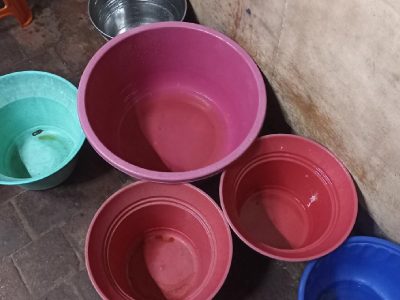
Despite launching multiple formal complaints with the water supply department, residents find their pleas routinely ignored. This forces them to live at the mercy of private water tankers that arrive only twice a week or to sink their own expensive tube wells into a rapidly depleting water table.
Further into West Delhi, in Dwarka’s Nasirpur neighbourhood, the deterioration of the water supply was ironically triggered by an attempt at civic modernisation. Approximately eight months ago, civic authorities finally acted on long-standing complaints regarding overflowing sewage by replacing thin, shallow surface pipes with thicker mains buried deep underground. Residents say the problems began after sewage infrastructure was upgraded about eight months ago.
Residents here report receiving three distinct types of substandard water on different days. “The supply switches between a brackish white fluid, a rough-textured brown liquid smelling heavily of human waste, and a bright yellow stream with a pungent odour,” said Rita Sharma, a resident.
Also Read: Delhi: 99.8% access on paper, zero pressure in the tap
Just as in Ghazipur, official water tankers rarely venture into these streets to provide relief. When they do arrive, they allegedly service only a select handful of favoured residences, leaving the rest of the community to fend for themselves.
Infrastructure breakdown
Audit findings, official accounts and resident complaints point to significant weaknesses in Delhi’s water distribution network.
A comprehensive, functional audit of the DJB conducted by the Comptroller and Auditor General (CAG) of India revealed a worrying statistic. Between 2017–18 and 2021–22, 55% of all groundwater samples tested by the DJB’s own zonal laboratories were substandard and entirely unfit for human consumption.
Out of the more than 16,000 samples analysed across the Capital, nearly 9,000 failed basic chemical and biological safety metrics. The CAG report highlighted that the city’s water shortages were actively worsening.
The auditor pointed out that the utility had made no effort to revise its outdated water charges periodically or to recover thousands of crores of rupees in outstanding dues from consumers.
Data indicate that the contamination does not originate within the primary treatment facilities. Testing samples illustrate that water leaving the major treatment plants generally meets safety criteria. However, it undergoes a drop in quality the moment it enters the city’s crumbling distribution network.
‘Ageing pipelines’
A senior DJB official, speaking on condition of anonymity, admitted that the vast majority of the underground pipelines supplying the Capital were ancient, corroded, and in a state of decay. They had not been refurbished or replaced in decades, leaving them vulnerable to external pressure.
Water Minister Parvish Singh Sahib also stated that around 50% of Delhi’s pipelines were 30 years old, indicating they would need a total overhaul. As of June 9, DJB has issued the largest number of tenders among all departments and institutions, with 336. Most of those are meant to fix pipelines and ensure the supply of clean water.
This advanced decay made it incredibly easy for external impurities – ranging from heavy metallic rust to raw sewage from parallel lines – to seep directly into the clean water supply.
‘Staff shortage’
Officials say that the board is beset by an acute staffing crisis: 30-40% of its essential engineering and monitoring posts remain vacant.
Due to the shortage of staff, senior supervisory engineers are routinely forced to manage up to nine separate departmental portfolios simultaneously. This operational overload renders round-the-clock water quality monitoring and swift emergency pipe repairs practically impossible.
The DJB had informed the Delhi Assembly that 49.3% of all sanctioned posts were vacant. The vacant posts include 513 senior assistant and 498 junior assistant positions, among others. Furthermore, the break-up divulged that the most vacancies existed in Group C posts (52.86%), Group B (38.32%), and Group A (32.8%).
According to DJB officials, these include vacancies dating back to 2023, when the water department needed 47 Junior Engineers.
26 daily complaints
Between 2021 and 2025, the DJB logged more than 43,000 unique complaints from residents about highly contaminated drinking water—the number of complaints made annually spiked from just over 2,500 in 2021 to 12,000 in 2022. On average, 26 new complaints about foul water were made every day over the last two years.
Delhi residents describe vividly how the water crisis has affected their daily lives. The crisis has breached the boundaries of informal settlements and is now actively affecting affluent areas in South Delhi.
Many individuals report being physically scarred by sudden, violent bouts of acute gastroenteritis and severe diarrhoea. They believe these infections were contracted directly from exposure to the municipal tap water.
Black water
In nearby Humayunpur village, families say the water that often flows from the tap is pitch black. It carries a heavy oil-like residue that quickly clogs and ruins expensive domestic water purifiers, leaving them with no viable alternative but to purchase commercial water jars at great personal expense.
“The situation is such that we have to keep registering complaints after complaints with the DJB, but we have not received anything akin to a solution yet. Even the more posh Safdarjung households receive brackish water, but due to them mostly using groundwater, they are not affected as much,” said Parveen Tomar, a resident who lives in a rented flat.
As per Pushkar Pawar, an urban planner empanelled with the Municipal Corporation of Delhi, “Flawed urban zoning laws and lax enforcement exacerbate the contamination of Delhi’s water network. In many areas across the Capital, small-scale industrial units involving heavy engineering, machine washing, chemical blending, and commercial spray painting are permitted to operate immediately adjacent to dense residential zones.”
He added that these facilities routinely operate in open backyards and unregulated areas, allowing vast quantities of hazardous wastewater containing industrial solvents, synthetic chemical residues, and toxic heavy oils to drain directly into the local stormwater network. “During downpour or routine washing, these chemical particles are swept into roadside channels that run parallel to the city’s drinking water pipelines,” he said, “Because the ageing water lines are riddled with cracks and structural fractures, the highly toxic industrial effluent mixes freely with the municipal supply.”
‘40% transmission loss’
Water Minister Parvesh Sahib Singh recently said that around 5,500 km of Delhi’s 16,634 km pipeline network is more than 30 years old and requires replacement.
Speaking to the media earlier this year, Water Minister Parvesh Sahib Singh admitted that “there is a heavy loss of water around 40% in the DSB canal (a major open waterway primarily used to supply raw water from Haryana to Delhi). The government has roped in IIT Roorkee to conduct a feasibility study to cover the canal and reduce losses of water”.
“We are taking steps to resolve the issues. Out of a 16,634 km water pipeline network, 5,500 km is 30 years old. There is a lot of leakage in these old lines. We are working to change all these lines to prevent water wastage and reduce contamination,” he added. Singh also said that the DJB is working on a project to cover the open DSB canal and supply water from a pipeline.